
The Perfect Little Children’s Home? draws together a range of expert perspectives on these developments and provides valuable insights for providers, commissioners and policy makers to ask the right questions and make careful, child-centred, evidence based decisions in the development of new and existing children’s home provision.
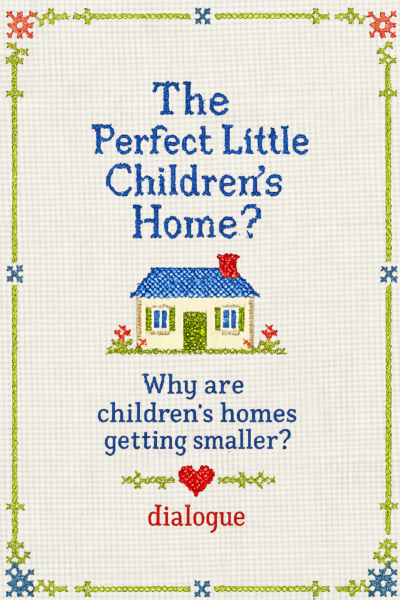
Order your copy today for just £29+P&P*, dialogue members can order for £24.50+P&P*
Postal orders will be processed each Friday, please ensure payment is received by 3pm on Thursdays to ensure you catch that week’s postal run.
The Perfect Little Children’s Home moves beyond the oversimplification of debates related to the role and purpose of residential care within child welfare systems, often predicated on ideologies, and raises questions about underpinning assumptions that are shaped by system dynamics, market forces, regulatory and inspection cultures, workforce capacity, and risk management strategies. This book does not offer simplistic solutions, nor does it seek to replace one perspective with another. Instead, it invites a more nuanced and critical conversation about what residential care is for, and how decisions about scale shape the wider children’s social care system.
Lisa Holmes PhD, Professor of Applied Social Science
This timely and accessibly written book makes essential reading for anyone concerned with the future of residential care in England. By moving beyond simplistic debates about size and risk, the authors offer a powerful reappraisal of what children’s homes are for and how they can best support children to thrive.
Professor Rick Hood, Professor of Social Work, Kingston University
There couldn’t have been a more important time for the sharing of these powerful and knowledgeable insights from folks steeped in the realities of providing and living in children’s homes.
June Thoburn, Emeritus Professor in the School of Social Work at the University of East Anglia
In 2016 an independent review of residential care raised concern the average number of children per home had dropped to 4, setting out this was more costly and there was no evidence it was better for children. Since that time the average has dropped further to 2.9 young people.
What is shaping this change? It’s not research nor national policy: there’s an absence of strategy at a national and local level.
Find out more…
The book begins with a history of the sector, before exploring the views of providers, commissioners, experts and young people themselves to try to understand the changes. We pull together some of the available evidence and apply this to ideas of scale, relationship and the difference children’s homes make in the lives of children and young people.
Launching at The Commissioners Conference in June 2026 this book is aimed at all those involved in opening children’s homes: the commissioners who should set the context of need in their areas, the providers who open homes that are required and Government who can create a healthy framework for the development of the right settings, in the right places, for the young people who need them.
The Perfect Little Children’s Home? aims to help people pause and reflect on these decisions and support the sector at another time of significant transition.
Here's a sneak peak of whats inside
Chapter 1
In Chapter 1, Steve Percival charts how societal attitudes to children’s homes have influenced the sector from Victorian workhouses in the 19th century to solo placements for young people deprived of their liberty today. He examines how personal values, societal needs, and media attention have changed the ways in which the sector operates, and how the legacy of large institutional orphanages still casts a shadow over the perception of residential care to this day.
Chapter 2
Chapter 2 explores the business development factors that have shaped the size of children’s homes. Andrew Rome has previously been commissioned by the DfE, Local Government Association, Regional Care Cooperatives, numerous local authorities, and the Children’s Homes Association to help analyse and reflect on the financial mechanisms underpinning children’s residential care. In this chapter, Andrew examines how business imperatives and the absence of proper strategic planning have affected the way in which children’s homes have grown over the last 25 years.
Chapter 3
In Chapter 3, Dr Kevin Gallagher considers how a home’s therapeutic approach affects home size planning. Dr Gallagher is Trustee Director of The Consortium of Therapeutic Communities and Managing Director of Amberleigh Care, a therapeutic community and employee-owned social enterprise. He will examine the importance of relationships for young people in care and how their place in the group, the organisation’s scale, and therapeutic model all influence a young person’s experience.
Chapter 4
Continuing the psychodynamic theme, in Chapter 4, Jonathan Stanley considers how organisational defences can create healthy as well as less healthy responses to trauma and uncontained anxiety in the residential care system. The former chief executive of the Children’s Homes Association, Jonathan brings decades of experience to understanding the relationship between local authorities and children’s homes, and echoes the conclusions of the NFJO’s (2025) push for a new ecosystem of care for children in complex situations.
Chapter 5
One of the significant factors in homes getting smaller (and at the heart of the NFJO work) has been the growth of deprivation of liberty (DoL) orders from the court, which are, at the time of writing, at record levels (Ministry of Justice, 2025). There is a common view in the sector that young people subject to DoL orders need to be placed alone. In Chapter 5, Jacqui McCann challenges this perspective, drawing on her direct practice experience and current doctoral research on the use of deprivation of liberty in children’s residential care.
Chapter 6
The lived experience of growing up in residential care is an essential perspective on the scale of children’s homes. In Chapter 6, Nick Scribbins takes us through his own childhood in residential care, and the influences of those around him. Nick subsequently went on to manage the children’s home he grew up in as well as other homes before working as a commissioner and, currently, as a Responsible Individual developing new provision. In this chapter, he examines how his own experiences have shaped his thinking, and how these intersect with some of the significant factors impacting on children’s homes today.
Chapter 7
Commissioners play a central role in arranging residential care for young people and linking young people’s wishes and feelings, their wider needs, and the availability of suitable places for them to live. Whether within local authority, health, education, voluntary or private sector accommodation, commissioners must forecast the needs of children and young people in residential care and plan for sufficient suitable places for them to live and to grow. Wendy Williams, in Chapter 7, draws on her commissioning experience and involvement in the South East Regional Care Cooperative pilot to reflect on the journey of young people she has worked on behalf of. Wendy considers approaches to understanding these needs, identifying the right homes, and then achieving the change young people and their families so badly need.
Chapter 8
Those running homes have a particularly close understanding of what works well. Victoria Elworthy has a strong track record in leading homes to good and outstanding judgements, both as a leader of a large national provider, and now as head of residential services for a Community Interest Company. In Chapter 8, Victoria explores how and why homes develop, shares analysis of how referral information drives provider strategy, and discusses her personal reflections on the myth that smaller homes are somehow easier to run.
Chapter 9
Chapter 9 examines wider perspectives on the size of children’s homes, which are, in general, smaller in England than further afield. Dan Hope is Chief Executive Officer of the charity SFAC – Strengthening Families and Children. His work is focused on supporting children’s homes globally to improve their child protection processes and systems, as well as enabling governments, NGOs, and local communities to re-provision residential care aligned to local cultural needs. Dan draws on the available research to consider what homes look like in the UK and abroad.
Chapter 10
Emmanuel Akpan-Inwang brought a model of children’s homes to the UK based on his Churchill Fellowship research of social pedagogy practice in children’s homes in Germany and Denmark. The model puts the wellbeing of the child at the centre of its activities, focusing on creating community, stability and lasting relationships, and has a particular focus on scale. In Chapter 10, Emmanuel describes this journey and the relevance to children’s homes in England, particularly in relation to training and leadership development.